- Blog
10/06/2026
What Is the Summer Slide? How to Support Learning Over the Holidays

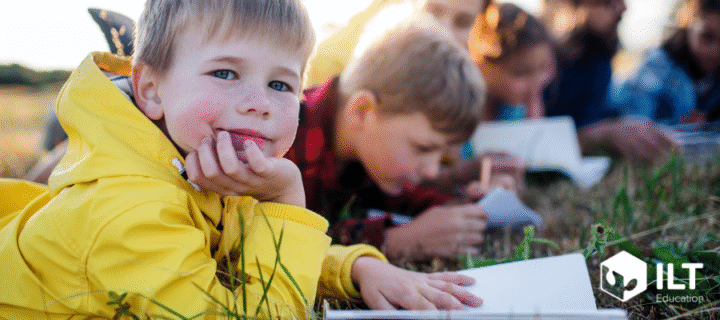
The summer slide is the learning loss that can happen when children are away from school for an extended break, particularly over the summer holidays. It can affect reading, writing, and maths, especially when children have fewer opportunities to practise these skills outside the classroom.
In early years and primary settings, progress is often built through repetition, conversation, and play (1,2,3). Children learn by hearing stories, joining discussions, counting objects, exploring the world around them, and using new vocabulary in context. Over the summer, those daily learning opportunities can become less frequent, which is why some children need time to settle back in when term begins again.
Research has shown that a seven-week summer break can lead to a measurable dip in learning, with some primary-aged children showing a decline in spelling scores after the holidays (4,5). The impact is often more pronounced for children from less advantaged backgrounds, which means summer can widen existing gaps before the new school year even begins.
The impact is not the same for every child. Some children continue to read, explore, and practise skills at home or through holiday activities. Others have fewer learning opportunities and less access to books, conversation, or structured play. Over time, that difference can widen the gap between pupils.
The summer slide can slow progress at the start of the autumn term, and it may leave some children needing time to rebuild confidence in their learning (4,5). A child who has lost confidence may hesitate more, take longer to respond, or need extra reassurance to re-engage with classroom routines.
Ensuring learning over the summer is not just about academic outcomes. It is also about protecting momentum, supporting well-being, and ensuring children return ready to build on previous learning rather than spending weeks catching up.
How Schools Can Support Families Over the Summer
One of the most effective ways to reduce the summer slide is to keep the message simple and positive. Families do not need a long list of tasks or formal worksheets. What helps most is knowing that small, everyday learning moments really do make a difference.
Schools can support families by sharing:
- A short list of easy summer ideas.
- Suggested reading books or stories.
- Simple maths games using everyday objects.
- Encouragement to talk, sing, count, sort, and explore.
- Information about local libraries, parks, and community activities.
The summer slide is real, but it is not inevitable.
With a few simple routines and plenty of everyday conversation and play, children can return in September ready to reconnect, refocus, and keep moving forward.
For early years and primary educators, understanding the summer slide is about more than preventing loss. It is about helping children maintain confidence, curiosity, and connection to learning throughout the year. A little support over the summer can make a meaningful difference when September arrives.
Need support with creating a summer plan for your class?

Fill out the form to download our Free summer slide resource pack!
Reference list
-
Education Endowment Foundation (2024) Play-based learning. Available at: https://educationendowmentfoundation.org.uk/early-years/toolkit/play-based-learning
-
Education Endowment Foundation (2025) Building learning in the early years: how conversations can change children’s learning. Available at: https://educationendowmentfoundation.org.uk/early-years/building-learning-in-the-early-years-how-conversations-can-change-childr
-
Queensland Government (2020) The power of repetition. Available at: https://earlychildhood.qld.gov.au/early-years/early-learning-at-home/read-and-count/the-power-of-repetition
-
Cooper, H., Nye, B., Charlton, K., Lindsay, J. and Greathouse, S. (1996) ‘The effects of summer vacation on achievement test scores: A narrative and meta-analytic review’, Review of Educational Research, 66(3), pp. 227–268. Available at: https://journals.sagepub.com/doi/10.3102/00346543066003227
-
Duff, F.J., Reen, G., Plunkett, K.B. and Nation, K. (2015) ‘Investigation of summer learning loss in the UK: a longitudinal study of literacy acquisition and retention’, PLoS ONE, 10(10). Available at: https://pmc.ncbi.nlm.nih.gov/articles/PMC5635200/
More Blog Posts