- News
30/03/2026
5 Practical Takeaways from the NLT’s ‘Early Words Matter’ Conference
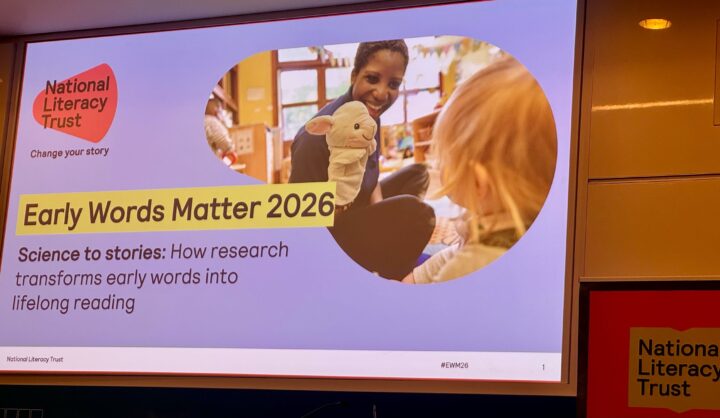
Navigating early years literacy in a digital world can feel like a constant balancing act. We recently spent the day at the National Literacy Trust’s Early Words Matter conference. The sessions stayed firmly rooted in the realities of modern Early Childhood Education, framing the actual steps practitioners can take to nurture literacy in a 'hyperconnected childhood'.
Here are five takeaways from the day to bring back to your setting:
1. Meet the 'hyperconnected' baseline without judgement
To support early literacy, we first have to understand the environment children are growing up in. The figures speak for themselves: 98% of two-year-olds in England view screens on a typical day, spending an average of 129 minutes on devices (Department for Education, 2026).
There is a sharp socio-economic divide here. Children in the lowest income quintiles log nearly double the daily screen time (179 minutes) compared to their most affluent peers (97 minutes). For families managing financial stress or time poverty, screens often act as a default coping mechanism. Our job isn't to judge this reality, but to offer accessible support that helps close the developmental gap.
2. Story books vs. 'AI slop'
Professor Sam Wass (Institute for the Science of Early Years and Youth) broke down the neurological differences between digital scrolling and physical reading. When children rapidly scroll through videos, they face a 'massive information' overload. This sensory barrage leaves little room for cognitive processing.
Story books do the opposite, providing 'little information' visually and aurally. This lighter load is exactly what activates 'generative learning'; the child’s brain has to do the heavy lifting to imagine the scene, predict what happens next, and process the narrative.
Professor Wass also warned about algorithmic 'AI slop'. These auto-generated stories lack the cohesive story structure of real children's literature, which is essential for helping a developing brain learn to sequence events and build attention.
3. Active engagement is key
The conference drew a hard line between passive consumption and active interaction. During the first five years, fast-paced media captures attention through 'bottom-up' mechanisms like loud noises and rapid scene changes. This sets off unpredictable dopamine loops, leading to what is commonly called 'brain rot'. Research even shows that just nine minutes of a fast-paced cartoon can instantly impair a four-year-old's executive function.
To counter this, we need to lean into 'top-down' digital play that requires problem-solving and activates higher order thinking potential. In practice, this means ditching passive screen time for interactive apps that make children think, connect and choose. Purpose, belonging and agency are central to every choice in the Early Years.
4. Shared storytime brings co-regulation
Whether you are sharing a tablet or a paperback, do it together. Professor Wass pointed out that shared storytime offers something beyond literacy: co-regulation. Sitting together helps an adult and child physically and emotionally sync up. The adult's calm presence regulates the child's nervous system.
For older children, this could also mean practicing Joint Media Engagement (JME). By co-viewing and asking questions like, 'Why is that character sad?', we prompt children to pause, think, and use their working memory. Tech should spark conversation, not replace it.
5. Use tech for equity and 'non-analogue' play
We shouldn't just banish technology; we can use it to tackle inequity. Digital tools offer immediate translation and audio support in a child’s home language, supporting EAL families and giving every child access to vocabulary-rich stories. High-quality, ad-free picture book apps can also hook reluctant readers, and support adults that struggle with literacy.
The day confirmed that even in a digital world, the 'human advantage' is still our ability to communicate, empathise, and think critically (National Literacy Trust, 2025). We should do the same with our intentional use of technology: communicate our purpose, grounded in connection and empathy, and remain critical to ensure tech serves our ends, not the other way around.
References
- Department for Education (2025) Early years foundation stage (EYFS) statutory framework. Available at: https://www.gov.uk/government/publications/early-years-foundation-stage-framework--2
- Department for Education (2026) 'Children of the 2020s' study data. As cited in: Digital Mediation and Neurodevelopmental Trajectories.
- National Literacy Trust (2025) The future of literacy: The human advantage. Available at: https://nlt.hacdn.org/media/documents/Future_of_Literacy_Report_2_Nov2025_Medium_Res1.2.pdf
- Parliament UK (2026) Screen time: impacts on education and wellbeing – Report Summary. Available at: https://publications.parliament.uk/pa/cm5804/cmselect/cmeduc/118/summary.html
- UCL Centre for Longitudinal Studies (n.d.) Toddlers spending two hours on screens a day. Available at: https://cls.ucl.ac.uk/toddlers-spending-two-hours-on-screens-a-day/
More News

5 Insights from the National Literacy Trust’s ‘Routes into Reading’ Conference